Tim Cann: Astro-imager | SRO Chief Engineer | IT Consultant
Circa 2003-2006
The primary telescope at SRO is a fork-mounted, 30-inch (0.76-m) Newtonian-Cassegrain reflector designed for multiple focal ratios of f/6 (Newtonian focus) and f/25 (Cassegrain focus). Upon its completion in 1963, the Stony Ridge's 30-inch telescope was the eighth-largest telescope in California, and some believed to be the largest amateur telescope in the world. As new technologies developed through the years, the members of the Stony Ridge Observatory endeavored to keep pace. Timothy Cann has been a longtime SRO and since 1979 its chief engineer. He has been a member of SRO's board of directors since 1981. Over the years he has continued to keep the parts of the mechanism called Stony Ridge Observatory repaired, maintained and moving forward.
Tim Cann’s first upgrade was to convert the telescope's electrical system, a 28-volt DC system, to a110 -volt AC system. Later the addition of a digital computer interface allowed the off-the-shelf telescope control software to read the telescope's position by adapting the mount's chain drives to work with Software Bisque's TheSKY, writing the windows computer control software and TELEAPI device support in C.
In 2005, Stony Ridge members began to encounter problems involving the tracking operation of the telescope that had operated for over 40 years without any major problems. After spending almost a year of unsuccessfully trying to determine the source of the problem, Timothy Cann recommended it was time for a major drive system upgrade to the telescope.
T. Cann is a professional IT consultant with the passion and skills to produce high-precision machine work. The new harmonic drive system for the SRO telescope was designed and built at Chronosmount, Inc., Tim Cann's machine shop in Temecula, CA. Chronosmount, Inc. is dedicated to developing and manufacturing the Chronos equatorial mount, a new, advanced telescope mount system based upon harmonic drive gearing.
To learn more about Chronosmount, Inc. visit the website at: www.chronosmount.com.
As an experienced astro-imager Tim Cann created this website in 2003 to share his photographic experiments using four different manufacturer's mounts and six different OTA's in addition to his self-built ones as well as blog about what he was doing at SRO. Sometime after 2006 this site’s domain expired. When I discovered the domain was available I decided to purchase it with the goal of recreating at least some of its content from archived pages. Unfortunately none of the images from 2003-2005 pages describing Tim’s experiments with digital development methods for making CCD images look like film images were retrievable. However I have included some of his comments. In addition I have added his informative 2006 comments documenting his efforts to use harmonic drives on an equatorial telescope mount.
As an amateur astronomer, I’ve spent countless nights under the stars, but discovering Tim Cann’s work has added a whole new dimension to my passion. His meticulous documentation of experiments—from harmonic drive systems to imaging techniques—has been fascinating to follow. The blend of engineering precision, problem-solving grit, and sheer love for the craft really speaks to me.
Recently, I bought my first serious telescope, partly inspired by Tim’s dedication. What I didn’t expect was how it would open a new chapter for my family. My teenage daughter, who is currently in therapy for bulimia, has taken a real interest in stargazing with me. Those quiet nights on the deck, aligning the scope and hunting for deep-sky objects, have become more than just an astronomy lesson—they’re moments of connection, trust, and shared wonder.
Watching her eyes light up when she sees Saturn’s rings or the glow of the Orion Nebula reminds me why people like Tim Cann matter. His passion not only advances the hobby for fellow enthusiasts, but it can also ripple out in ways he might never imagine—helping families bond, sparking curiosity, and even supporting someone’s healing journey. Roger Sherman
++++++
2006 Posts
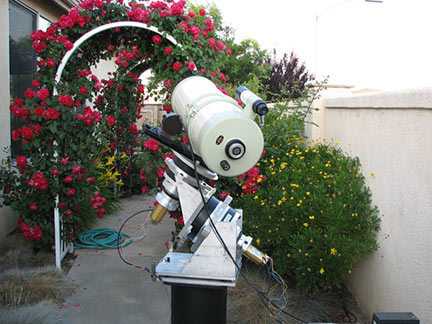
This website documents my efforts to use harmonic drives on an equatorial telescope mount. The ultimate goal is to replace the drives at Stony Ridge Observatory (SRO). But, to keep my sanity, I've decided to build a complete telescope in my back yard, using the same drives that will ultimately be attached to SRO's 30” fork mount (http://www.stony-ridge.org). The testing will occur here.
This is a running log of the project's progress:
May 31, 2006 First Light!
++++++
June 3, 2006 You Don't Know Until You Know!
Since the success of the “First Light” night, it's been a struggle! To say the least. So let me give you the good news before the I tell you of the saga of how we got here. The good news is that last night (June 2) I was able to:
- Use the go-to functions of the Bisque Telescope Control System (BTCS)
- Perform four T-Point models
- Polar align the mount using T-Point
- Complete the hardware installation of the mount
How this all came to be is best summarized by: You don't know what's wrong until you really know what's wrong. Sort of like your feelings when you've misplaced your car keys saying when you finally find them: “Now I know where they were.”
First some background. The harmonic drives are each made up of two drives attached in tandem. The first, on both RA and Dec provide a 50:1 reduction and is the stage that was manufactured to accept the Pittman brush-less servo motors that came with BTCS. The second harmonic drive, the one that will attach directly to SRO, provides another 160:1 reduction. These two drives, or stages, give a total reduction of 8,000:1 and was the design point on which I've based all of my calculations.
(What makes a motor a “servo motor” is the addition of an encoder to the drive shaft. This encoder communicates with BTCS and helps it keep track of where the telescope is pointing.)
The encoder on each drive divides each motor revolution into 2,000 parts which along with the 8,000:1 reduction produces 16,000,000 identifiable parts (BTCS calls them Tics) of a 360 degree circle. That means that BTCS can theoretically position the drives to an accuracy of 0.081 arcseconds. (The encoders currently on SRO divide a circle into 36,000 parts.)
So, given these details which I entered into the BTCS setup screens, the system should have been able to have properly gone from the Moon to Saturn without much difficulty. (They were quite close together on Thursday.) Instead, BTCS moved the telescope (what appeared to be) about double the required distance. Well that did not make any sense to me and it didn't make any sense to Steve Bisque either! We have been debating this for two days and, not any surprise, Steve say's: “BTCS cannot make such an error.”
On top of that, in my early hours of testing, BTCS would shutdown (reboot) almost immediately when executing a high speed slew. Rebooting takes about 10 seconds and my blood pressure was rising each time it did that (beep-beep-beep out of the controller)!
What I discovered about 2:30 am this morning is that the two harmonic drives we have are not the same ratio! Yep, instead of sending me two drives each with 8,000:1 reductions, the RA drive is 5,000:1, which explained why the mount was going too far. (The control system would say, to go to Saturn: move 375,309 tics when it should have been telling it to move 234,568 tics.) Duh! And I was blaming Steve Bisque. Hopefully he'll have a laugh about it when I tell him on Monday.
As for the reboot problem, that one still needs work. I've been able to work around the problem by restricting the maximum slew speed. I believe we'll be able to work that one out.
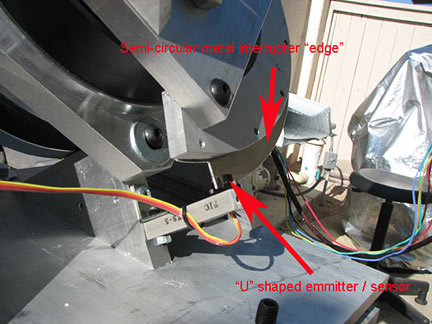
More hardware was added yesterday to complete the installation. Some of you have been asking about my e-mail about pointing accuracy. BTCS finds “home” by using two semi-circular pieces of metal, one mounted on each axis. BTCS seeks out the end of each piece of metal and when it finds it, calls that home. (In much the same way we home SRO by pushing the button on the computer when the scope is anchored down.) This all works because the computer knows the correct time.
++++++
June 5, 2006 CCD Test Images
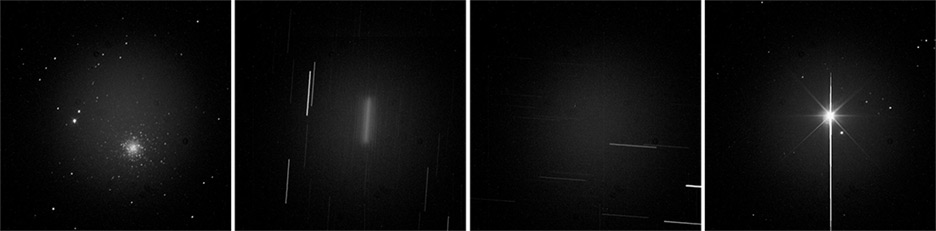
Last night was a very successful experiment that had a single goal: test the harmonic drives under the most demanding of tasks, CCD imaging. A byproduct of these tests was to verify the drives' ability to be guided, and of course, to be able to find objects, and center and focus them. The results: the drives passed with flying colors, in fact, more successfully than I could ever have hoped. Where can I buy one of these for my backyard?
Not to go over things that are already on this website, but, please allow me to review:
The images were taken at 2600mm focal length, just over ½ of SRO's. Polar alignment was close, but certainly could be made closer with T-Point. Both azimuth and altitude were about 1 arcminute off the pole. And, the German equatorial mount was not balanced, in fact by most measurements it was terribly out of balance; there were no counterbalance weights at all. On my Paramount it takes 40lbs of counterweights to balance the same OTA and cameras, and that does not take into account the fact that the harmonic drive on the Dec axis weighs 37lbs and is on the same side of the RA axis as the telescope. Try that with a worm-and-wheel gear system. Neither RA or Dec were balanced
Now, on to the images. Remember, these images were taken to test the harmonic drives, not to create pretty pictures. Note: these images had no dark frames or flat frames applied, no callibration, which is why the center area is not completely black like the edges.
Equipment:
- Takahashi CN-212 Cassegrain, 2600mm focal length prime focus
- SBIG STV autoguider, 100mm focal length f/4 imaging lens
- SBIG ST-1001e CCD camera, 24 micron pixels, 1024x1024 array
- Images were taken at –10 degrees C.
- Harmonic drive German equatorial mount, 5,000:1 RA, 8,000:1 Dec
- Bisque Telescope Control System (BTCS) w/Pittman Series 5433 brush-less servo motors
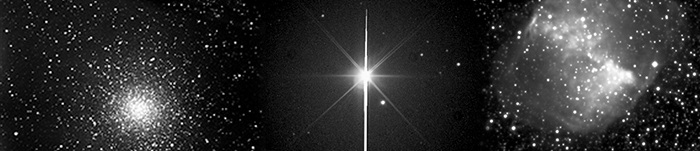
This is a 60 second exposure of Regulus. Regulus is badly bloomed, as would be expected.
Now, let me spend a few minutes talking about the experience of using the harmonic drives. I've had the pleasure of using a number of very fine telescope mounts: Bisque's Paramount, Takahashi EM-200 and the usual array of Celestron and Meade mounts. At no time did I have to center Regulus or M53. The process went like this:
- Power up the mount
- Tell BTCS to find home
- Use TheSKY to tell the telescope to go to Regulus (it was about 20 degrees west of home)
- Take the image
- Use TheSKY to tell the telescope to go to M53 (it was about 45 degrees east of Regulus
- Take the rest of the images
Both objects were perfectly centered in the field of view of the CCD camera. At no time did I have to “Sync” on a known star. The homing procedure was ample alignment. One more experience that is totally new to me. Before taking these images I used a Canon 20D to take some "preliminary" images. I'd mounted and connected the 20D before homing the telescope. HOWEVER, the change to the SBIG ST-1001e was accomplished with the mount guiding on a star near Regulus! That's right, I made a major camera change including all of the extra hardware (threaded adapters, Optec IFW, SBIG camera and it's cables) all while the STV was doing it's thing. Never once did the STV loose the guide star.
So, what's next? Certainly I'd like to perfect the polar alignment. Also on the agenda is to create a T-Point model to measure pointing accuracy.
In short: I could not be more pleased!!
++++++
June 5, 2006 Down for Repairs
The out-of-spec harmonic drive is on its way back to Hauppauge, NY. The vendor was quite apologetic about their mistake. Their inventory confirmed that they had shipped the wrong ratio.
It is important that both harmonic drives be the same ratio because we want the high-speed-slew to be the same speed for both axes. I decided, and the vendor agreed, that we would make the Dec drive 5,000:1 instead of making the RA drive (the one that was shipped wrong) 8,000:1. Everything that I've written up to this point says that the ratios are 8,000:1, so those of you who are keeping track, and keeping notes, need to change them. When we get done, both axes will be 5,000:1 with a corresponding pointing accuracy of 0.129 arc seconds (instead of 0.081) as reported earlier. Bisque recommends a ratio of between 2,000:1 and 8,000:1, so this change will keep us within their recommendations. By the way, the vendor has committed to having the changed Dec drive back to me before the weekend. So, I'll be unable to do any more testing until it's back.
While dismantling the setup this morning I discovered that the ST-1001e SBIG camera was not anchored well, so it looks like my unguided image was “operator error” rather than a problem with the drives. Charlie was the first to point out my mistake. I'll plan to confirm this when we're back on-line.
The stars are clearly two separate round images, confirming that the camera moved during the exposure. We'll see if a 5 minute unguided image produces nice round stars instead of this mess. It is not unreasonable to expect a properly set up system to be able to produce round stars unguided in an exposure only 5 minutes long. Before I do this test again, I'll plan to work on polar alignment more, and to set the Siderial rate more accurately.
++++++
June 15, 2006 Ugh... Lots of Words
The last week has been very busy! The corrected harmonic drive assembly got here last Friday as promised by the manufacturer. By dark Friday I'd reassembled everything and was ready for bear. Before it was completely dark the night-and-early-morning-low-clouds had rolled in, stopping any activity of importance. Fortunately the remaining nights starting with last Saturday have been increasingly friendly to my testing. Most nights I was out from about an hour before dark till about 10 or 11. Twice I was back up at 3 or 4 to do more. Beth has been understanding, sort of.
I had a number of goals for the week and I believe as much has been accomplished that could have been with me still working during the day. I took several more images, one which I'll share with you is a 30 minute guided and calibrated image of M51.
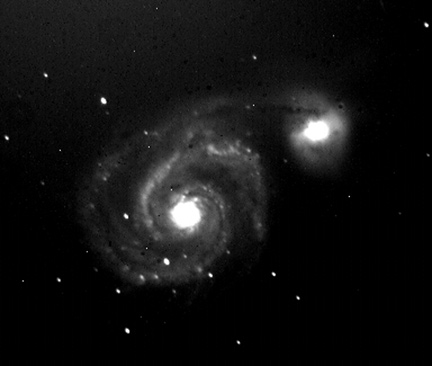
I've done a number of additional T-Point models with great success. Pointing accuracy has been as good as I've ever experienced with a robotic telescope mount. With the camera attached I've been able to slew to any object desired without having to locate and center the object, it was simply there in the camera. This has even been true when the mount must switch sides (a trait of German equatorial mounts but not fork ones). And there has been continued success with guiding using the Santa Barbara Instruments STV auto-guider (which the M51 image attests to). Using the STV as my auto-guider insures that there is always a guide star, which makes photographing a real pleasure. Note: the STV is guiding a 2,600mm telescope using a 100mm lens to image the guide stars. This is probably too short for this long a focal length imaging system and will also be too short for SRO's 4,500mm focal length. I will plan to guide through a longer focal length telescope as my testing continues.
It has turned out that my assumption that the multiple-star-images in the unguided picture (see the June 5, 2006 CCD Test Images page, second picture) was not a loose camera mount, but is in fact uneven tracking. Verification of that was simple: take more images unguided with the camera firmly attached. The real challenge has been dealing with BTCS' insistence on shutting down during high speed slew. This has been an intermittent issue from the beginning and this past week has given me the time and concentration to get my arms around it.
To explain in detail, please let me go over a number of things about our setup. (This was covered on the June 3 posting, I'll repeat it here, before going on, changing the gear ratios to reflect the change made last Friday):
I will be using a number of acronyms, so let me define each of them now for your reference:
BTCS – (Software Bisque's) Bisque Telescope Control System, the electronics and software that will replace the hardware and software that currently controls the chain drives at SRO.
PEC – Periodic Error Correction, a built-in capability of BTCS that enables modeling the periodic error inherent in gear systems that repeat on a very specific cycle. Even the low cost computerized telescopes from Celestron and Meade have PEC.
Tic – Servo motor jargon used to describe the electrical pulses generated by the encoder. Our servo motors generate 2,000 tics per motor revolution. Think of it as a very fast clock tic.
T-Point – Software included with BTCS that allows us to model the polar alignment, harmonic drive gear inaccuracies and telescope mount flexure to give us more accurate pointing.
TheSKY – Software included with BTCS that is an on-computer-screen star chart. TheSKY interacts with BTCS to let us point at an object on the computer screen, click on it, and tell the telescope we want it to slew to that object.
The harmonic drives are each made up of two harmonic drives attached in tandem. The first provides a 50:1 reduction and is the stage that was manufactured to accept the Pittman brush-less servo motors that came with BTCS. The second harmonic drive, the one that will attach directly to SRO' mount, provides another 100:1 reduction. These two drives, or stages, give a total reduction of 5,000:1 (50 x 100).
(What makes a motor a “servo motor” is the addition of an encoder to the drive shaft. This encoder communicates with BTCS and helps it keep track of where the telescope is pointing.)
The encoder on each drive divides each motor revolution into 2,000 parts which along with the 5,000:1 reduction produces 10,000,000 (50 x 100 x 2,000) identifiable parts (BTCS calls them Tics) of a 360 degree circle. That means that BTCS can theoretically position the drives to an accuracy of 0.1296 arcseconds. (The encoders currently on SRO divide a circle into 36,000 parts.)
Now for the new stuff. Imagine what is going on inside BTCS. While it is driving the RA motor to compensate for the Earth's rotation, the encoder is feeding pulses (tics) from the encoder at 2,000 counts per motor revolution. While tracking, the RA motor rotates just over three times a minute. That means that BTCS is receiving over 6,944 encoder tics per minute while tracking. The electronics and software inside BTCS is watching each of those tics and is deciding, real time, exactly what time to tell the motor to move on to the next tic. (It is this design that allows BTCS to correct for pointing errors modeled by T-Point, and for it to correct for PEC. BTCS modifies the “when” to move on to the next tic based on the models.)
Now, this process, real time correction of when to move on to the next encoder tic, is also being performed while the telescope is being slewed. It is this encoder-tic counting that enables BTCS to perform the go-to functions of moving the telescope to a specific object in the sky based on our request for it to go to, for example, M51. BTCS calculates the number of encoder tics from Mars to M51 (for example), turns on the motors (it know which direction), and counts tics until the telescope is pointed at M51. At high speed slew the motors are rotating at up to 4,000 revolutions per minute (RPM). That means that BTCS must watch those encoder tics 8,000,000 times per minute (133,333 times per second). For a computer this is not really all that hard, even though it seems hard to us.
BTCS imposes some safety rules while moving the telescope for us, fast or slow. It knows where the horizon is, for example, and it knows that the telescope tube cannot go so far south that it runs into the fork. We are also able to tell it of arbitrary obstructions that we'd like to avoid. We could, for example, tell it where the trees are so we would be told that a tree is in the way if we ask BTCS to go to an object this is behind one. (I'm not sure how detailed we will ultimately get on this, but we have the flexibility to do whatever we wish.)
As important as all of these BTCS safety rules are, it also looks at a more important one. It watches the amount of power it is supplying the motors and decides, real time, if the power being supplied is “too much.” This means that if the telescope were to run into something that we have not modeled, the amount of power required to move the telescope against that obstruction would be too high and BTCS would shut down before damaging anything. These power limits have been set arbitrarily by BTCS based on the “norms” of the motor and “typical” gearing designs.
And there is the rub. The harmonic drives have a well documented trait called “torque ripple.” I wrote about it in a number of my early project e-mails and studied a number of papers posted on the Internet. It would appear that BTCS is receiving feed back, probably through the motor's electrical feed back mechanisms, or perhaps, through variations in the nature and timing of the encoder tics, that BTCS does not feel is normal, and shuts down.
The shut downs occur at slew speeds only. I've tried to get BTCS to shut down by putting my shoulder under the telescope while it is tracking, the harmonic drives simply ignore my shoulder and drive me into the pavement. So there is something about the nature of the harmonic drives that, at slew speeds, freaks out BTCS and it shuts down with an annoying beep-beep-beep, requiring a re-boot. I've been able to work around this by restricting the maximum slew speed to about 1,000 RPM at the motors. This translates into a horizon-to-horizon slew time of about 3 minutes.
Which in itself is OK, but I'm determined to find a way to fix this. I've been talking extensively with Steve Bisque about finding a way to solve this by modifying the BTCS software to accommodate this nasty trait.
A second item has also surfaced. I'd hoped to model out PEC to improve tracking smoothness. (PEC could correct for the double star images we discussed earlier and I showed images of in the June 5, 2006 CCD Test Images page.) BTCS uses a standard PEC cycle of about 4 minutes. It is supposed to be able to handle a PEC cycle of up to about 10 minutes. Our harmonic drives' PEC cycle is 14 minutes, 24 seconds. Steve Bisque is also looking into modifying BTCS software to allow us to extend the amount of PEC correction. Without PEC, we have no chance of doing unguided exposures longer than about one minute.
Let me be frank. It could be a long road to modifying BTCS to accommodate our use of harmonic drives. Our other choice, use Ed Byers gears, is a choice we should perhaps re-visit. I would like to have an extended discussion about changing direction with Byers gears as the central component of that change. I would like to postpone that discussion to another day. I'd like to give another web page posting that task, perhaps tomorrow.
So what's next? Certainly there needs to be a great deal more discussion with Software Bisque. That might even involve sending them one of our harmonic drives. Last night is used a special utility provided by Steve Bisque that allowed me to graph the motors and encoder tics. I did a number of graphs including normal tracking, slewing at working speeds and slewing leading up to a shutdown. I've sent the results of those tests to Steve for his comments.
We will need to discuss our options which includes Byers gears and perhaps even using BTCS with the chain drives. I will try to put my thoughts together over the weekend and post it in a new wordy web page.
As always, your thoughts, comments and criticisms are welcome!
++++++
June 21, 2006 The Grind
Since my last posting things have been “busy” but not satisfying. For all of you at SRO, allow me to go over some specifics:
The shutdown challenge has not changed. BTCS shuts down at slew speeds above about 30% of maximum. The closer (but less than) the setting is to 30% of maximum, the more often a shutdown occurs.
At 30% the horizon-to-horizon slew time is about 3 minutes.
Even slight temperature changes affect the maximum slew speed that is possible. I don't have much temperature range here, 80F – 90F in the day, 50F during the night. The 30% slew speed maximum works consistently during the heat of the day, while early in the morning when everything has cooled down, 25% or even 20% is necessary to stop the shutdowns. NONE OF THIS MAKES MUCH SENSE TO THE EXPERTS. I've gone over this at nausea with Steve Bisque and with the people at Harmonic Drive LLC (HDSI) and both say this small of a variation in temperature should have no effect.
Steve is away from his office enough that I'm often frustrated by the length of time it takes for a response to a question I've posed, or to his response to information requested by him that I've sent. I've been as quick as possible to answer his questions, or to provide information that he asks for. Steve and I talked last Monday for nearly an hour, but little has come of it.
HDSI on the other hand has been more than helpful. I spent nearly two hours on the phone with them reviewing everything. They even offered to take the drives back to see if reloading a thinner lubricant, or even a different input bearing might help. They offered to swap out the input stage (50:1) from the existing harmonic drive for a planetary drive which would be slightly more efficient. They reviewed all of the technical information about BTCS that is available on Bisque's Web page; they also reviewed the Pittman specification sheets. HDSI concluded that the Pittman motors that Bisque supplied are more than capable of performing up to spec (4,000 RPM) when attached to the systems that they delivered. The bottom line is that they say the possible modifications would have only slight effect on the shutdown sensitivity.
HDSI manufacturers their own servo control electronics and points to their numerous high-precision pointing successes using their harmonic drives. Specifically they point out that their drives operate the antennae on the Mars Rovers and on numerous space satellites. They insist that the “torque ripple” that has been discussed and discussed some more is so small compared to the delivered torque of the Pittman motors, that it cannot be causing the BTCS shutdowns.
I purchased the Molex connectors that BTCS uses to attach the motors and built a break-out harness that allows me to monitor voltage and current levels while the motors are operating (using a storage scope / meter combination). I sent those numbers to Steve as well.
I suggested to Steve that perhaps it would be better if he and HDSI talked directly to take me out of the middle of their respective positions that the other is at fault. I also asked Steve to let me talk to his controller-board engineer to see if he and I might be able to get some things done while Steve is unavailable.
I've spoken to half a dozen manufacturers of servo motor controllers to see if there might be an off-the-shelf piece of hardware that could be mounted between BTCS and the Pittman motors. Some say that what I'm asking can't be done, others say that such an electronic device would have to be designed and built custom. Do any of you know a slick electronics hardware wizard?
I've been passing my time in the evenings doing more photography and T-Point models, but at times I've been asking myself: “What's the point?” until we move beyond the shutdowns.
Let me apologize to all of you because some of my frustration is probably showing here, but I want to keep you all informed about what is going on. This is typical of the process of integrating systems that have never been proven or that have never worked together. It is my opinion that we'll eventually find a solution. I'd be much happier if I had control over everything, but unfortunately we'll need to rely on our vendors to help us get through this.
By the way, and this needs to be said: Steve has offered to refund us our money (less a restocking charge). I still do not feel this is a viable option. BTCS has much superior function to the other electronic control systems I reviewed, and certainly has a larger install base of satisfied customers.
++++++
Posts 2004-2005
Picture Details: No Image Available
Date: 03/17/2004; Seeing: 5; Transparency 5 & hazy; Temperature: 72F
Object: NGC2244 The Rosette Nebula
Telescope: FSQ-106 f/5 w/Orion Deep Sky Filter on EM-200 Temma
Camera: Canon EOS Digital Rebel
Guider: SBIG STV eFINDER
Exposure: 19 - 210 second exposures (summed)
Processing Using ImagesPlus -
>Canon RAW Convert to TIFF(16); Dark Calibrate; Alignment: Transform Only; Adaptive Add;
> Color Digital Development (Breakpoint 1,691, Background Weight 1.06, Background 0);
> Geometric Transforms (Scale) from 3,072 x 2,048 to 768 x 512
++++
Picture Details: No Image Available
Date: 03/29/2004; Seeing: 5; Transparency 5 & partly cloudy; Temperature: 70F
Object: M51 The Whirlpool Galaxy
Telescope: CGE-1100 f/10
Camera: Canon EOS Digital Rebel
Guider: SBIG STV eFINDER
Exposure: 13 - 210 second exposures (summed)
Processing Using ImagesPlus -
> Canon RAW Convert to TIFF(16); Dark Calibrate; Alignment: Transform Only; Adaptive Add;
> Color Digital Development (Breakpoint 14,503, Background Weight 1.00, Background 0);
> Geometric Transforms (Scale) from 3,072 x 2,048 to 768 x 546
++++
NEW DARK FRAME ANALYSIS ADDED AFTER THE SIX IMAGES.
The following six images were taken on three different nights. Here is the information about them that is common to all six:
Date: See each image- No Images Available
Object: M42 The Orion Nebula
- Telescope: FSQ-106 f/5 w/Hutech 2" LPS Filter; EM-200 Temma II
- Camera: See each image
- Guider: SBIG STV through a 105mm f/2.8 lens
- Exposure (each image): 8 - 210 second exposures
Image #2: Nikon D70; IR blocking filter in place; ISO 800
Date: 12/18/2004; Seeing 7; Transparancy 7; Temperature: 60F; Dark Calibrated
Image #3: Canon 20D; IR blocking filter in place; ISO800.
Date: 12/19/2004; Seeing 7; Transparancy 7; Temperature: 60F; Dark Calibrated
Image #4: Canon 20D; IR blocking filter removed; ISO800.
Date: 01/12/2005; Seeing 8; Transparancy 8; Temperature: 49F; NO Dark Calibration
Image #5: Canon 20D; IR blocking filter removed; ISO200.
Date: 01/12/2005; Seeing 8; Transparancy 8; Temperature: 49F; NO Dark Calibration
Image #6: Canon Digital Rebel; IR blocking filter in place; ISO800 :
Date: 12/19/2004; Seeing 7; Transparancy 7; Temperature: 60F; Dark Calibrated
+++++++
Next I'd like to compare the dark frames from each of these three cameras. Please note that dark frames are not effected by the presence or absence of the IR filter.
ImagesPlus' Digital Development function was used to process each of the preceding six images. It was also used to process each of the three dark frames that follow. Specifically, the Auto Button was used to set Digital Development parameters on each of the six images and each of the three dark frames that follow. (This would not be done to dark frames used for calibration.)
Here is a quote from ImagesPlus' help file that describes Digital Development:
Digitial development is a method for making CCD images look like film images. To accomplish this goal three differences between a CCD sensor and film need to be addressed.
1) The gamma curve of a CCD needs to be transformed into the gamma curve of film. The Background and Break-Point controls are used to transform the linear gamma curve of a CCD into the S-shaped gamma curve of film.
2) An edge emphasis effect needs to be introduced into a CCD image. The Edge/Color Emphasis Low Pass Filter controls provide this effect'
3) Color is highly enhanced by modern color film, so a method for emphasizing the color of a CCD image needs to be applied. The Color Emphasis controls provide this effect.
Stretch Parameters:
- Background: The slider sets the low level of the S-shaped gamma curve.
Backgd Wt. This slider is used to adjust the background weight that is applied to the image. A value of 0 means do not apply a background correction. A value between 0 and 2 can darken the background and add contrast to the image.
Break-Point: The slider sets the middle or point of inflection of the S-shaped gamma curve.
The Auto button sets the Background and Break-Point automatically. The resulting image is usually a very good starting point for further refinement. The Auto button is optimized for low contrast underexposed images such as deep sky objects.
++++++
Now, on to the dark frames: For each of the dark frames, pressing the Auto Button on the Digital Development Dialog Box resulted in the following parameters:
- 20D, D70 and Digital Rebel
- Apply to: Red Green Blue
- Operation : Digital Development
- Background : 0
- Background Weight : 1.00
- Sharpening Filter :None
The ONLY parameter that was different between the three cameras was the Break-point parameter. They were:
- 20D: Break-Point = 18D70: Break-Point = 1452
- Digital Rebel: Break-Point = 30
- EOS350D: Break-Point = 300
What I believe this all means is that in the case of the D70 the "...point of inflection of the S-shaped gamma curve..." is higher, nearly a hundred times higher, than either the 20D or the Digital Rebel. Much more noise in the D70. The 350D is ten times that of the old Rebel and over 16 times that of the 20D.
Looking at each of the three dark frames certainly supports the conclusion that the D70 has considerably more noise than the 20D or Digital Rebel. Further, the 20D seems to have a very even distribution of noise across the entire CCD while the Digital Rebel has a decided gradient growing towards the right side and the D70 has a very high level of noies (probably processor heat) to the top left. The 350D has two gradients.
To take this analysis farther, what follows are darks from each of the four cameras. This time the generation of the darks followed this procedure:
1. Take 20-210 second dark frames with the camera's body cover in place and black tape over the vewfinder eyepiece. All 80 dark frames were taken at 71F.
2. Average the last 10 dark frames in each set using the IP operation: Image File Operations | Combine Files | Average
3. The resulting image for each camera was then processed using IP Digital Development, and again as above, using the Auto button to set the parameters. All settings were as above except:
Break Point for
- 20D=250
- 350D=79
- 300D=93
- D70=1689
The purpose of this processing was to make the dark frame's dark-to-light contour visible.
4. Each set of 20 TIFF files were examined using IP Cross Hair Statistics recording the statistics for all 80 images. This data was stored in Excel and then graphed. The graphs follow the dark frames.
5. The same statistics was recorded for the resulting averageddark frames (before the Image Development was applied):
20D
- Min=7
- Max=28059
- Avg=385.402
- Median=137
- Dev=448.252
- Entropy=5.755
- Symmetry=0.319
350D
- Min=7
- Max=50881
- Avg=113.269
- Median=49
- Dev=150.992
- Entropy=5.009
- Symmetry=0.404
300D
- Min=7
- Max=25729
- Avg=146.881
- Median=77
- Dev=166.909
- Entropy=5.114
- Symmetry=0.410
D70
- Min=0
- Max=65535
- Avg=2437.463
- Median=1161
- Dev=2870.238
- Entropy=8.086
- Symmetry=0.432
More Backgrounds On TCann.com
TCann.com is a specialized astronomy website associated with Timothy “Tim” Cann, an astrophotographer, information technology consultant, precision machinist, and longtime contributor to Stony Ridge Observatory in Southern California. Originally established in 2003, the website documented Cann’s experiments with astronomical imaging, digital cameras, telescope mounts, and the engineering challenges involved in modernizing a large amateur-built observatory.
Unlike commercial astronomy websites that concentrate on selling telescopes or publishing general-interest articles about space, TCann.com developed around practical experimentation. Its content offered readers an opportunity to follow the work of an experienced amateur astronomer who understood not only how to operate sophisticated equipment but also how to design, modify, and troubleshoot it.
The website is particularly noteworthy for its documentation of harmonic-drive telescope mounts, a technology that offered an alternative to traditional worm-gear mechanisms. Cann's experiments during 2006 helped illustrate both the possibilities and complications of applying these precision gearing systems to astronomical tracking.
TCann.com also preserves an important chapter in the history of digital astrophotography. Its earlier material examined cameras such as the Canon EOS Digital Rebel, Canon EOS 20D, Nikon D70, and Canon EOS 350D at a time when digital single-lens reflex cameras were becoming increasingly useful for photographing nebulae, galaxies, and other deep-sky objects.
Although the website eventually disappeared from its original form, a later domain owner reconstructed portions of its historical content. The resulting website serves as a record of Tim Cann's experiments and a reminder of the technical contributions amateur astronomers have made to observational astronomy.
Origins and History of TCann.com
Tim Cann established TCann.com in 2003 to share his experiences as an astrophotographer and telescope equipment experimenter. His interests extended beyond capturing attractive astronomical images. He wanted to understand how different combinations of telescopes, cameras, guiding systems, and mechanical mounts performed under actual observing conditions.
The original website reportedly documented his experience with mounts from four manufacturers and six optical tube assemblies, along with equipment he built himself. This breadth of experimentation distinguished the site from more conventional astrophotography galleries.
During 2004 and 2005, TCann.com included detailed records of imaging sessions, camera comparisons, exposure settings, and digital image processing techniques. The information reflected an important transitional period when amateur astrophotographers were evaluating the advantages and disadvantages of increasingly affordable digital cameras.
By 2006, the website's emphasis had expanded to include a major telescope engineering project. Cann was investigating whether harmonic-drive gearing could replace the aging drive mechanisms of Stony Ridge Observatory's 30-inch telescope.
His project reports documented technical progress, unexpected failures, conversations with equipment manufacturers, and the practical lessons learned through testing.
Sometime after 2006, the original domain registration expired. A subsequent owner acquired TCann.com and attempted to reconstruct selected pages using archived website material. Unfortunately, many original astrophotographs were no longer recoverable.
The reconstructed website therefore emphasizes written records, equipment descriptions, experimental observations, and engineering reports rather than functioning as a complete restoration of the original photography collection.
This distinction matters when considering ownership. Tim Cann was the original creator and subject of the historical material, but the later website restoration was undertaken by a different domain owner. The available information does not establish the present registrant's legal identity or indicate that Cann operates the reconstructed website.
Tim Cann: Astrophotographer, Engineer, and Technology Consultant
Timothy Cann's work brought together several disciplines that are particularly valuable in amateur astronomy: computer programming, mechanical engineering, precision machining, electronics, and observational photography.
Professionally, Cann worked as an information technology consultant. His astronomical interests, however, required capabilities extending far beyond conventional computer support.
A large astronomical telescope depends on mechanical components that must move substantial weight with extraordinary precision. Even slight tracking errors can cause stars to appear elongated in photographs, particularly during long exposures or when using telescopes with substantial focal lengths.
Cann's combination of programming and mechanical skills allowed him to address problems involving both physical telescope movement and the computer systems controlling it.
His work included upgrading electrical systems, developing computer interfaces, adapting telescope positioning mechanisms, and evaluating advanced motor-control technologies.
Stony Ridge Observatory's official history independently recognizes Cann's contributions to the facility. Its account describes his work maintaining the observatory and modernizing the telescope's systems over several decades.
Cann became the observatory's chief engineer in 1979 and joined its board of directors in 1981, according to the biographical information preserved on TCann.com.
His activities also extended to Chronosmount, Inc., a precision-machining and telescope-mount development venture associated with Temecula, California.
Together, these activities established Cann as a technically accomplished participant in the amateur astronomy community, particularly among observers interested in high-performance telescope mounting systems.
Stony Ridge Observatory and Its Importance to TCann.com
Stony Ridge Observatory provides the institutional and historical background necessary to understand much of TCann.com's engineering content.
Located in the Angeles National Forest in Los Angeles County, California, the observatory occupies a mountainous site approximately six miles north-northeast of the famous Mount Wilson Observatory.
Its elevation is approximately 5,700 feet, providing access to mountain skies away from some of the atmospheric and lighting conditions encountered in the Los Angeles basin.
The observatory was established through the efforts of amateur astronomers who wanted to construct a substantial research-capable instrument without relying on a university or major government observatory.
The organization traces its roots to the Association of Amateur Astronomers, established in 1947. By 1957, approximately 15 members were committed to developing the Stony Ridge facility.
Construction culminated in the completion of its principal telescope in 1963.
The instrument, known as the Carroll 30-inch telescope, was designed by George A. Carroll. It is a Newtonian-Cassegrain reflector with a primary mirror approximately 30 inches, or 0.76 meters, in diameter.
The telescope was designed to operate at different focal configurations, including f/6 at Newtonian focus and f/25 at Cassegrain focus.
When completed, it ranked among California's largest telescopes and was exceptionally ambitious for an instrument constructed and operated by amateur astronomers.
Its substantial aperture made it suitable for observing faint celestial objects, obtaining astronomical photographs, and supporting scientific investigations.
Stony Ridge also became involved in lunar mapping work associated with preparations for the Apollo era. Its collaboration with Lockheed helped support the production of detailed lunar observations.
The observatory's history therefore reaches beyond recreational stargazing. It represents a notable example of amateur astronomers contributing equipment, observing time, and technical expertise to larger scientific projects.
TCann.com's connection to Stony Ridge is especially important because Cann's engineering experiments were intended to help preserve and modernize this historically significant facility.
Modernizing the Carroll 30-Inch Telescope
The Carroll telescope was originally constructed using mechanical and electrical technologies appropriate to the early 1960s.
Its drive mechanism employed an ingenious dual-chain arrangement developed by George Carroll. The system allowed the telescope to follow the apparent motion of celestial objects across the sky.
Because Earth rotates, an astronomical telescope must move continuously to keep a distant object centered. For an equatorially mounted telescope, this normally involves rotating its right ascension axis at the sidereal tracking rate.
The original Stony Ridge system successfully performed this task for decades, but technological developments eventually made improvements desirable.
One of Cann's early projects during the 1980s involved converting the telescope's electrical systems from their original 28-volt arrangement to a 110-volt AC-based system.
This required significant modifications to the drive electronics and associated components.
Later, Cann helped introduce computer-based telescope positioning. By adapting the existing mechanical system to communicate with software, he enabled operators to determine where the telescope was pointing.
Software Bisque's TheSKY played a role in this modernization. Cann also developed computer-control and interface software using the C programming language.
However, the system still had an important limitation.
Although the computer could determine the telescope's position, it could not fully command the existing drive mechanism to move automatically to selected objects.
This distinction between monitoring telescope position and controlling telescope movement became central to the next phase of Cann's work.
By 2005, problems with the telescope's aging tracking system prompted consideration of a more extensive mechanical upgrade.
Cann proposed replacing the original drive arrangement with a harmonic-drive system capable of supporting computer-controlled pointing and tracking.
The project became one of the most technically detailed subjects documented on TCann.com.
Understanding Harmonic-Drive Telescope Technology
A harmonic drive, also called a strain-wave gear, is a precision gearing mechanism that uses controlled deformation of a flexible component to transmit rotational movement.
Traditional astronomical mounts commonly use worm-and-wheel gear systems. These mechanisms can provide excellent tracking accuracy, but they require careful manufacturing, adjustment, and maintenance.
Harmonic drives offer several potential advantages, including high reduction ratios, compact construction, substantial torque capacity, and very low backlash.
Backlash is the small amount of mechanical play that can occur when a gear system reverses direction. In astronomical photography, excessive backlash can complicate guiding corrections and reduce tracking precision.
Cann recognized that harmonic-drive gearing might provide a practical alternative for the large Stony Ridge telescope.
Rather than immediately modifying the observatory's primary instrument, he decided to construct a separate experimental telescope mount at his home.
This approach allowed him to evaluate the technology without unnecessarily risking the observatory's existing equipment.
His test mount used a German equatorial configuration, while the Stony Ridge telescope employed a fork mount. Despite the mechanical differences, the drive technology could be tested under realistic astronomical observing conditions.
The experiments required integrating harmonic-drive assemblies, brushless servo motors, electronic encoders, and the Bisque Telescope Control System.
One of the original configurations combined a 50:1 reduction stage with a 160:1 stage, producing a total reduction ratio of 8,000:1.
With encoders providing 2,000 counts per motor revolution, the theoretical positioning resolution was approximately 0.081 arcseconds.
However, theoretical resolution does not automatically translate into equivalent real-world pointing or tracking accuracy. Mechanical flexure, gear behavior, polar alignment, atmospheric conditions, and electronic control all influence actual performance.
Cann's experiments were particularly valuable because they exposed these practical differences.
The 2006 Telescope Engineering Journal
The engineering journal preserved on TCann.com provides a detailed account of the harmonic-drive experiments conducted during May and June 2006.
On May 31, Cann reported achieving first light with the experimental telescope system.
In astronomy, first light describes the initial successful use of a telescope or instrument to observe celestial objects.
By June 2, the system had demonstrated several important capabilities. Cann was able to use computerized go-to commands, construct multiple TPoint pointing models, perform polar alignment, and complete the mechanical installation.
However, the early successes were accompanied by frustrating technical problems.
The telescope sometimes moved considerably farther than commanded. Initially, the behavior suggested a possible software or control-system problem.
After extensive investigation, Cann discovered that the supplied harmonic-drive assemblies did not have matching reduction ratios.
One axis had a total reduction of 5,000:1, while the other had the originally specified 8,000:1 ratio.
Because the controller had been configured using incorrect assumptions about the mechanical gearing, its calculated movements did not correspond to the telescope's actual motion.
The discovery illustrates a fundamental engineering principle: sophisticated control software cannot compensate for incorrect information about the equipment it operates.
The manufacturer acknowledged the discrepancy, and Cann arranged for the assemblies to be configured with matching 5,000:1 reductions.
The revised system provided a theoretical encoder resolution of approximately 0.1296 arcseconds.
Although slightly coarser than the original design, this remained an extremely fine positioning increment.
Tracking Accuracy, Software Problems, and Engineering Challenges
The incorrect gear ratios were not the only difficulty encountered during testing.
Cann also discovered that the Bisque Telescope Control System sometimes shut down during high-speed telescope movements.
These movements, known as slews, allow a computerized telescope to travel from one celestial target to another.
At lower speeds, the system operated successfully. At higher speeds, however, the controller could unexpectedly reboot.
Cann investigated whether the problem involved motor current, servo feedback, encoder signals, or the mechanical characteristics of harmonic gearing.
One suspected factor was torque ripple, a phenomenon involving small variations in the torque transmitted through a drive mechanism.
He discussed the issue with Steve Bisque of Software Bisque and technical representatives of Harmonic Drive LLC.
The manufacturers offered different interpretations of the problem, and Cann documented the difficulty of diagnosing an unfamiliar combination of components.
He also constructed an electrical breakout harness that allowed him to monitor motor voltage and current while the system operated.
The troubleshooting process revealed that restricting the maximum motor speed could prevent shutdowns, although this reduced the speed at which the telescope could move between targets.
At one stage, the experimental telescope required approximately three minutes to slew from one horizon to the other.
Another challenge involved periodic error correction, commonly abbreviated PEC.
Periodic error refers to tracking inaccuracies that repeat as gears rotate. Telescope control systems can compensate for predictable variations when their timing and magnitude are properly modeled.
Cann found that the harmonic-drive system exhibited an error cycle longer than the standard correction period supported by the controller.
This made long unguided photographic exposures difficult.
The website's detailed discussion of these problems is particularly useful because it demonstrates how real engineering projects evolve. Progress did not follow a simple sequence of design, construction, and success.
Instead, Cann repeatedly revised assumptions, gathered measurements, consulted manufacturers, and reconsidered possible solutions.
Astrophotography Experiments and Deep-Sky Imaging
Although telescope engineering became a major focus, astrophotography remained central to TCann.com's identity.
The original website contained detailed accounts of photographing astronomical objects using different telescopes, cameras, and processing methods.
One experiment involved the Rosette Nebula, also designated NGC 2244 in reference to the associated star cluster.
On March 17, 2004, Cann photographed the region using a Takahashi FSQ-106 telescope operating at f/5, an Orion deep-sky filter, and a Canon EOS Digital Rebel camera.
The exposure sequence consisted of 19 individual exposures of 210 seconds each.
The resulting images were processed using ImagesPlus software, with operations including RAW conversion, dark-frame calibration, image alignment, and digital development.
Another experiment, conducted on March 29, 2004, focused on Messier 51, commonly known as the Whirlpool Galaxy.
For that session, Cann used a Celestron CGE-1100 telescope at f/10 with a Canon EOS Digital Rebel camera.
The photographic sequence consisted of 13 exposures of 210 seconds each.
The original photographs are not available in the reconstructed website, but the surviving records provide useful information about the techniques and equipment employed.
Cann also documented imaging experiments involving Messier 42, the Orion Nebula.
These experiments compared the performance of different digital cameras and infrared-filter configurations.
His records included observations about exposure settings, calibration methods, sensor noise, and differences in camera behavior.
For modern readers, these details provide a useful historical perspective on the development of consumer digital cameras for astronomical imaging.
Comparing Canon and Nikon Digital Cameras
One of the most technically interesting subjects preserved on TCann.com concerns digital camera noise.
During 2004 and 2005, Cann compared several cameras, including the Canon EOS 20D, Canon EOS 300D Digital Rebel, Canon EOS 350D, and Nikon D70.
Digital sensors generate unwanted electronic signals that can appear as noise in astronomical photographs.
This becomes particularly important during long exposures, when faint celestial objects must be distinguished from background noise.
Cann investigated these differences using dark frames.
A dark frame is an exposure made without allowing light to reach the camera's sensor. It records electronic noise, thermal signal, and other unwanted patterns that may be present during normal imaging.
Dark-frame subtraction can help improve the quality of astronomical photographs by removing predictable components of this unwanted signal.
For one experiment, Cann captured 20 dark frames from each camera, using 210-second exposures at a temperature of approximately 71°F.
He then processed and analyzed the resulting images using ImagesPlus.
His recorded measurements included minimum and maximum pixel values, averages, medians, standard deviations, entropy, and other statistical characteristics.
The Nikon D70 exhibited substantially higher measured dark-frame signal and variation in this particular experiment than the Canon cameras.
Cann also observed different spatial patterns of noise, including gradients that appeared to be associated with internal camera electronics or heat.
These findings were specific to the equipment, operating conditions, and processing methods used in his experiments. They should not be interpreted as universal performance rankings for every camera model.
Nevertheless, the comparisons illustrate the practical concerns that astrophotographers faced when selecting digital cameras in the early 2000s.
Digital Development and Astronomical Image Processing
TCann.com also explored the use of digital development techniques to produce images resembling traditional film photography.
During the transition from photographic film to digital sensors, image processing became an increasingly important part of astrophotography.
Film and digital sensors respond differently to incoming light. Digital images often require adjustments to brightness, contrast, color, and tonal distribution to reveal faint astronomical details.
Cann used ImagesPlus software to investigate these adjustments.
One important technique involved transforming the tonal response of a digital image through a nonlinear curve.
This allowed faint structures to become more visible while controlling the appearance of brighter areas.
The software also provided methods for adjusting background levels, emphasizing edges, and enhancing color.
Cann experimented with processing parameters such as breakpoint values and background weighting.
His documentation is valuable because it records not only which software was used but also the specific settings applied to individual imaging sessions.
This type of information helps other astrophotographers understand how an image was produced and provides a foundation for repeating or improving an experiment.
Although modern astronomical processing applications offer more sophisticated tools, the underlying principles remain relevant.
Noise reduction, calibration, alignment, image integration, contrast adjustment, and careful color processing continue to be essential parts of digital astrophotography.
Chronosmount, Inc. and the Development of a New Telescope Mount
Cann's experience with harmonic-drive technology also contributed to the development of Chronosmount, Inc., a venture associated with his precision-machining operations in Temecula, California.
The company's Chronos equatorial mount was designed around harmonic-drive gearing rather than a conventional worm-gear arrangement.
Its development reflected the same engineering interests documented on TCann.com: precision movement, reduced mechanical backlash, computer-controlled positioning, and the ability to support substantial telescope equipment.
By 2007, the ChronosMount was attracting attention among serious amateur astronomers.
Discussions on the Cloudy Nights astronomy forums examined its unusual drive mechanism, potential performance advantages, and comparison with established premium telescope mounts.
Participants discussed the possibility of operating substantial telescope equipment without the large counterweights normally associated with German equatorial mounts.
Some expressed enthusiasm about the mechanical design, while others questioned how its control electronics would perform compared with established systems from manufacturers such as Software Bisque and Astro-Physics.
These discussions are important because they demonstrate that Cann's engineering work had reached an audience beyond the Stony Ridge Observatory membership.
The ChronosMount was being evaluated within a community of experienced telescope users familiar with the demands of high-resolution astrophotography.
An account published on the Australian astronomy forum IceInSpace also identified Cann as the developer behind the mount and described its use of harmonic-drive technology.
That discussion connected the project with telescope-making gatherings and the wider international astrophotography community.
The available historical references establish that ChronosMount attracted interest, but they do not provide reliable current sales figures, production totals, or verified long-term customer satisfaction statistics.
The Station Fire and the Observatory's Survival
One of the most dramatic events in Stony Ridge Observatory's later history occurred in 2009, when the Station Fire swept through the San Gabriel Mountains.
The wildfire threatened both Mount Wilson Observatory and Stony Ridge Observatory.
The danger attracted coverage from the astronomy publication Sky & Telescope, which reported on the uncertain fate of the facilities as the fire advanced.
Stony Ridge was particularly vulnerable because of its remote location and surrounding vegetation.
For several days, observers had difficulty determining whether the observatory had survived.
Fortunately, subsequent reports confirmed that the principal telescope dome and administration building had escaped destruction.
The surrounding landscape suffered extensive fire damage, and the event complicated ongoing observatory operations and engineering work.
Stony Ridge's official account explains that the fire delayed further testing and use of the upgraded telescope system.
The observatory's subsequent restoration history also records the reinstallation of the original George Carroll-designed right ascension and declination drive systems by 2017, along with additional improvements.
This later development provides important context for TCann.com's 2006 engineering journal.
Cann's harmonic-drive experiments represented a substantial and historically significant modernization effort, but the observatory's mechanical configuration continued to evolve afterward.
Public Recognition, Reviews, and Media Coverage
TCann.com was a specialized technical website rather than a mainstream astronomy publication. Its influence is best understood through the relevance of its material to experienced astrophotographers, telescope builders, and amateur observatory operators.
There is no reliable public traffic data establishing how many people visited the original website, and no verified evidence of major awards specifically presented to TCann.com.
Likewise, the available sources do not establish that the website received formal editorial ratings or widespread consumer reviews.
However, several independent sources confirm the significance of the work associated with Tim Cann.
Stony Ridge Observatory's official website acknowledges his long-term engineering contributions and documents the electrical, mechanical, and computer-control upgrades he helped implement.
Sky & Telescope has published extensive coverage of Stony Ridge Observatory, including its historical importance, scientific activities, and survival of the 2009 Station Fire.
The publication also included Stony Ridge in its astronomy organization directory, with Tim Cann identified as a contact.
Meanwhile, Cloudy Nights discussions from 2007 demonstrate contemporary interest in the ChronosMount and its unconventional engineering approach.
These sources do not establish broad commercial popularity for TCann.com itself. They do, however, provide independent evidence that Cann's work belonged to a recognized community of technically sophisticated amateur astronomers.
Audience and Educational Value
The primary audience for TCann.com consists of people interested in practical astronomy and the technology behind astronomical observation.
Experienced astrophotographers may find the camera comparisons, calibration methods, exposure records, and equipment descriptions particularly useful.
Telescope builders and mechanical engineers may be more interested in the harmonic-drive experiments, gear reduction calculations, servo motor behavior, and troubleshooting procedures.
Computer programmers and electronics enthusiasts can also learn from the discussions of telescope-control software, encoder feedback, and motor-controller integration.
For beginners, the material may initially seem technical. Nevertheless, it offers an unusually direct introduction to the challenges of producing high-quality astronomical images.
One of the website's most useful lessons is that successful astrophotography depends on an entire system rather than any single piece of equipment.
A premium telescope cannot produce consistently sharp long-exposure images if its mount does not track accurately.
Similarly, excellent tracking cannot eliminate camera noise, incorrect calibration, or poor image processing.
Cann's experiments demonstrate how these factors interact.
The website is also useful to historians interested in the transition from film-based amateur astronomy to digital imaging and computerized telescope operation.
Cultural and Social Significance
TCann.com reflects a tradition in amateur astronomy that extends back centuries: individuals pursuing scientific knowledge through personal experimentation, instrument construction, and the sharing of observations.
Amateur astronomers have long contributed to discoveries involving comets, asteroids, variable stars, planetary observations, and other astronomical phenomena.
Stony Ridge Observatory is an especially notable example of this tradition because its members built and maintained a large research-capable telescope through volunteer effort.
Cann's work represents a continuation of that culture.
Rather than treating the telescope as a finished instrument, he approached it as a system that could be improved through experimentation and engineering.
The original TCann.com also reflects the early internet's role in spreading specialized technical knowledge.
Before video tutorials, social media communities, and modern collaborative platforms became widespread, personal websites often served as important repositories of practical experience.
An individual working on a difficult engineering problem could publish detailed notes that might help others facing similar challenges.
Cann's willingness to document failures as well as successes made the material especially valuable.
The surviving journal does not present technological development as effortless. It shows uncertainty, mistakes, vendor disagreements, mechanical revisions, and repeated testing.
That openness is part of the site's enduring educational significance.
Ownership, Location, and Present-Day Status
TCann.com is an internet-based resource, not a physical observatory, restaurant, museum, or retail establishment.
Its historical subject, Tim Cann, was closely associated with Stony Ridge Observatory in the Angeles National Forest and with precision-machining activities in Temecula, California.
The Stony Ridge facility is situated near Mount Wilson in the San Gabriel Mountains, while Temecula is located in southwestern Riverside County.
These locations are relevant to Cann's work, but neither should be confused with a verified business address for the current TCann.com website.
The website was originally created by Cann in 2003. After the original domain expired, it was acquired by another owner who reconstructed selected historical materials.
The current site is therefore best described as a restored historical resource devoted to Cann's astrophotography and telescope engineering work.
It does not appear to function as a conventional online store, and there is no documented restaurant-style menu, admissions pricing schedule, or commercial service catalog associated with the reconstructed site.
Its principal offerings are historical articles, experimental records, technical explanations, and accounts of astronomical equipment development.
The publicly available information does not establish the identity of the current legal registrant, the site's traffic volume, or whether additional restoration work is planned.
Why TCann.com Remains Relevant
The equipment discussed on TCann.com belongs largely to the early and middle years of the 2000s, but many of the problems explored on the site remain familiar to astrophotographers.
Modern telescope mounts still require accurate polar alignment, reliable tracking, appropriate motor control, and careful management of mechanical error.
Digital cameras continue to generate noise that must be understood and controlled.
Long-exposure imaging still depends on the relationship between optical equipment, tracking systems, environmental conditions, and processing techniques.
Harmonic-drive technology has also become increasingly visible in modern astronomical mounting systems, making Cann's earlier experiments interesting from a historical perspective.
His reports demonstrate that the application of a promising mechanical technology involves much more than selecting a gear with attractive specifications.
Motors, controllers, software, electrical feedback, mechanical loading, and operational requirements must all work together.
For readers interested in the development of modern amateur astronomy, TCann.com offers a detailed case study of that integration process.
TCann.com occupies a distinctive place in the history of amateur astrophotography and telescope engineering.
Originally created by Tim Cann in 2003, the website documented experiments involving digital cameras, astronomical image processing, telescope mounts, and the modernization of Stony Ridge Observatory's historic 30-inch reflector.
Its surviving material captures a period when digital photography and computerized telescope control were transforming the capabilities available to serious amateur astronomers.
The website is especially valuable for its detailed 2006 journal describing the development and testing of harmonic-drive telescope mechanisms.
Those reports reveal the practical difficulties of integrating precision mechanical components with sophisticated electronic control systems.
Independent records from Stony Ridge Observatory, Sky & Telescope, and astronomy discussion communities help establish the broader significance of Cann's contributions.
Although the original website's photographic collection has not been fully recovered, its preserved technical documentation continues to offer historical and educational value.
Ultimately, TCann.com illustrates how dedicated amateur astronomers can contribute to technological innovation, preserve important scientific instruments, and share knowledge that remains useful long after the equipment itself has changed.